
>
Partner of the Year 2024 — Simplex Fire DetectionISO 9001 · 14001 · 45001 Certified
suppression

Clean Agent Gas Suppression Systems

Put the fire out without destroying what it has not reached — inert gas and Novec 1230 systems for rooms where the contents are the business.
Explore Applications
Gas Suppression Systems
Overview

What Is Clean Agent Suppression?

Water is an excellent extinguishing medium and a poor one for rooms full of electronics. A sprinkler discharge in a data hall or a control room will very likely stop the fire, and will just as likely destroy the equipment the fire had not yet reached.

Clean agent suppression avoids that trade. An inert gas system floods the protected volume and reduces oxygen to a level that will not sustain combustion but remains survivable. A chemical agent such as Novec 1230 (FK-5-1-12) absorbs heat from the flame front faster than it can be generated. Both leave no residue and require no clean-up beyond ventilating the room.

  • No residue and no conductivity Servers, switchgear and archives come through a discharge intact.
  • Sized to the volume Agent quantity is calculated to reach and hold the design concentration.
  • Proven, not assumed A room integrity test at commissioning shows the enclosure will hold the agent.
  • Interlocked with the building Detection, dampers, air handling and door release work as one sequence.
Operation

How Clean Agent Suppression Works

01

Detect

Two independent detectors must confirm before anything is released.

02

Warn and hold

Occupants are alerted, with a discharge delay and a manual lock-off.

03

Discharge

The agent floods the enclosure and reaches design concentration within seconds.

04

Hold concentration

A sealed room keeps the agent long enough for the fire to be properly out.

Benefits

Why Choose Clean Agent Suppression?

Equipment survives

The fire is suppressed without wetting or contaminating anything.

Fast knockdown

Design concentration is reached in seconds, not minutes.

Engineered to the room

Agent quantity follows a volume calculation, not a rule of thumb.

Integrity proven

Room integrity testing at commissioning demonstrates the hold time.

Safe for occupants

Discharge delay, clear warning and a manual lock-off while anyone is inside.

Maintained under AMC

Cylinder weighing, interface testing and refill handled on schedule.

Applications

Applications Across Critical Environments

Clean agent systems are bought for the damage they do not do — chosen where recovery time matters more than the cost of the room.

Also used for telecom facilities, museum stores and marine applications. Whether an inert gas or a chemical agent suits depends on the room, its occupancy and its ventilation, which the site assessment establishes.

Configuration

Inside a Clean Agent Suppression System

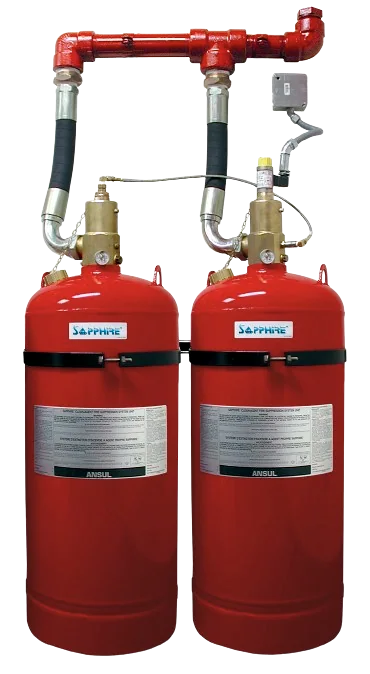
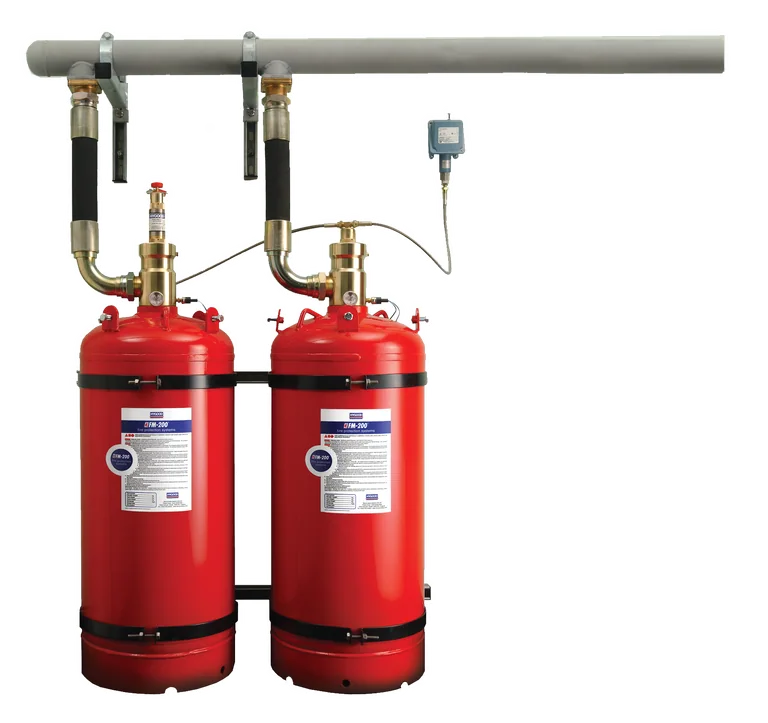
  • Agent cylinders and manifold inert gas or Novec 1230, sized to the protected volume.
  • Discharge nozzles and pipework designed so the agent reaches concentration throughout the room.
  • Detection and release panel with double-knock confirmation before any discharge.
  • Occupant warning and lock-off discharge delay, sounders, signage and a manual hold facility.
  • Pressure relief and interlocks sized to the enclosure, with damper and air-handling shutdown.
  • Design, commissioning and maintenance including room integrity testing and cylinder weighing under AMC.
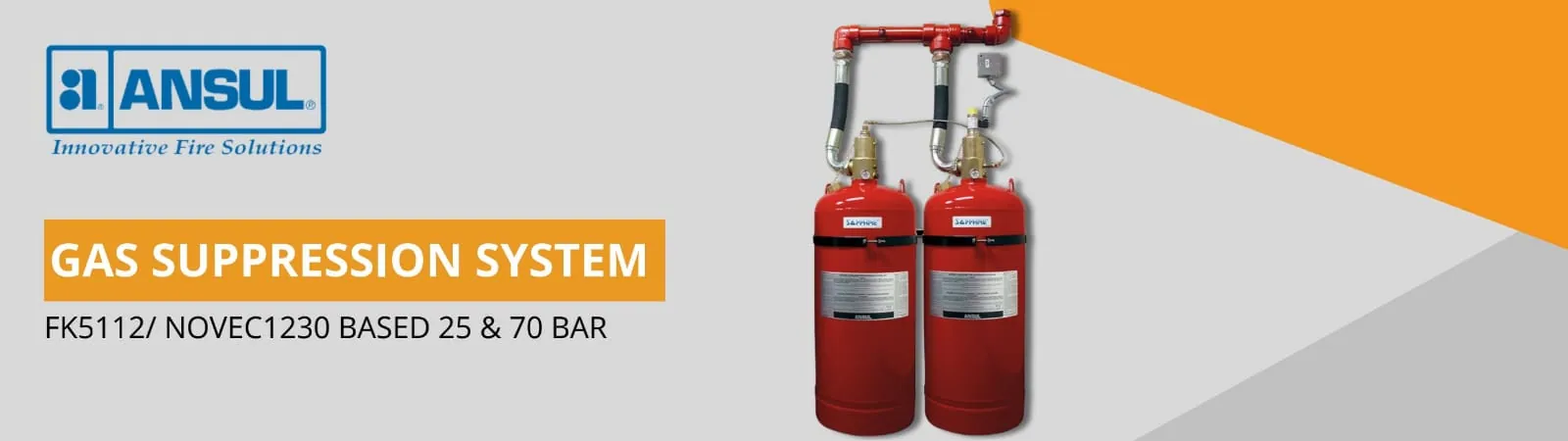
ANSUL clean agent gas suppression system
A clean agent suppression installation: agent cylinders, manifold and the pipework that distributes to the nozzles.
Products

Products We Supply

The clean agent ranges we are an authorised partner for.

Our services

End-to-End Gas Suppression Solutions

  • Site assessment and risk review walking the actual space before anything is specified.
  • System selection and application engineering matching the technology to the environment and the risk.
  • Volume calculation and room integrity testing so the coverage you pay for is the coverage you get.
  • Integration with existing fire alarm systems including the cause-and-effect for any linked response.
  • Installation, testing and commissioning with the installed system proven on handover.
  • Preventive maintenance and technical support under AMC, with a documented service record.
Compliance

System Integration and Compliance

Standards and approvals

Gaseous extinguishing systems are designed to IS 15493 and the international practice of ISO 14520 and NFPA 2001 for agent concentration, hold time and enclosure integrity.

This sits within Part 4 of the National Building Code (NBC 2016), and the completed installation forms part of what your state fire service assesses for the fire NOC. Room integrity testing is part of commissioning rather than an optional extra.

We confirm agent and component approvals against the certification held by the specific system proposed, and against your consultant's specification and insurer conditions.

FAQ

Frequently Asked Questions

What facility and project teams usually ask about clean agent suppression.

Still have a question?

Speak directly with one of our fire safety engineers.

Call +91 88795 33000
What is a clean agent?
An extinguishing agent that leaves no residue and does not conduct electricity — typically an inert gas blend or a chemical agent such as Novec 1230 (FK-5-1-12).
Is it safe for people in the room?
Systems are designed so the concentration suppresses fire while remaining survivable, with a discharge delay, clear warning and a manual lock-off. Occupancy is part of the design.
Why does the room have to be sealed?
The agent has to hold its concentration long enough for the fire to be properly out. An unsealed cable entry or an oversized door gap will leak it away regardless of how much is installed.
What is a room integrity test?
A measured test at commissioning that establishes how long the enclosure will hold the agent. It is how you know the system will actually work.
What happens after a discharge?
The room is ventilated and the cylinders are refilled. There is no clean-up of residue, which is why recovery is measured in hours rather than weeks.
Can it be retrofitted to an existing room?
Often yes, but the enclosure usually needs sealing work first. The integrity test establishes what is required.
What do you need to quote a project?
Room dimensions and construction, what is in it, occupancy, ventilation and damper arrangements, and whether it is a new installation or a replacement.
Engineered to your hazard class

Protect Critical Rooms Without Water Damage

Talk to our team about a clean agent suppression solution sized to your room, its contents and its recovery requirements.
+91 88795 33000
Chat with an expert
CallWhatsApp