

>
Partner of the Year 2024 — Simplex Fire DetectionISO 9001 · 14001 · 45001 Certified
detection

Lithium-ion Battery Safety Systems

Catch thermal runaway in the only window that matters — off-gas detection for battery rooms, UPS rooms and energy storage, before a cell ignites.

Explore Applications
Overview

What Is Lithium-ion Off-Gas Detection?

Lithium-ion failures behave differently from almost every other fire risk, and the difference decides how they have to be detected. A failing cell does not smoulder in the ordinary sense. Internal resistance rises, the cell heats, the electrolyte begins to decompose, and the cell vents a mixture of flammable and toxic gases through its safety vent. Only then does it ignite.

That sequence is the opportunity. The venting phase happens before ignition and produces a gas signature quite unlike ordinary smoke. A detector tuned to those electrolyte vapours responds during it. Conventional smoke detection, waiting for combustion particulate, generally responds only once the cell is already alight — too late to isolate, ventilate or move anything.

  • Tuned to the off-gas Detection targets the electrolyte vapours cells release as they begin to fail.
  • Responds before ignition The alarm comes during venting, while intervention still changes the outcome.
  • Per module or string Monitoring is arranged so the alarm identifies which unit to isolate.
  • It drives a response Charge stop, string isolation, ventilation and alarm rather than notification alone.
Operation

How Off-Gas Detection Works

01

Monitor the space

Detectors sample the air around the battery modules continuously.

02

Identify the signature

The system responds to electrolyte vapour rather than combustion particulate.

03

Alarm during venting

The alert comes while the pack is heating, before any cell ignites.

04

Isolate and ventilate

Charging stops, the string is isolated and extraction clears the gas.

Benefits

Why Choose Off-Gas Detection?

Earlier than smoke detection

It responds during venting, not after a cell has already ignited.

Built for cells

Targets the electrolyte vapour signature specific to lithium-ion failure.

Identifies the module

Monitoring per string tells you which unit to isolate.

Stops the charge

Interlocks to charge control and string isolation, not just an alarm.

Clears the gas

Ventilation interlock removes flammable vapour before it accumulates.

Limits propagation

Intervening early is what keeps the event to a module rather than a room.

Applications

Applications Across Critical Environments

Once propagation starts, thermal runaway is self-sustaining and very difficult to stop. Everything useful happens before that point.

Guidance in this area is still developing and insurer requirements vary considerably. We design to the current requirement of your authority and insurer, and state in writing what has been applied.
Configuration

Inside a Battery Safety System

  • Off-gas detectors positioned to sample the air around the modules at risk.
  • Controller and monitoring arranged per module or string so the alarm identifies the unit.
  • Charge and isolation interface to stop charging and isolate the affected string.
  • Ventilation interlock to clear flammable vapour before it can accumulate.
  • Alarm and remote indication local warning plus reporting to the fire system or BMS.
  • Design, commissioning and maintenance including placement study and functional testing at handover.
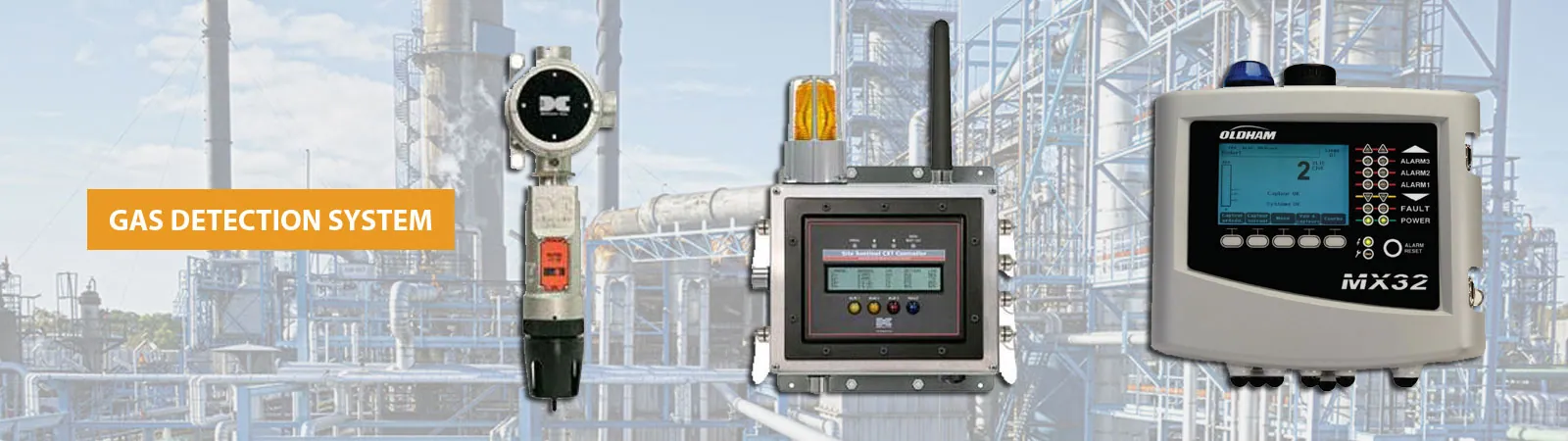
Gas detection equipment used for battery off-gas monitoring
Off-gas detection uses gas sensing rather than smoke detection, because the warning arrives as vapour, not particulate.
Our services

End-to-End Battery Safety Solutions

  • Site assessment and risk review walking the actual space before anything is specified.
  • System selection and application engineering matching the technology to the environment and the risk.
  • Detector placement study for battery rooms so the coverage you pay for is the coverage you get.
  • Integration with existing fire alarm systems including the cause-and-effect for any linked response.
  • Installation, testing and commissioning with the installed system proven on handover.
  • Preventive maintenance and technical support under AMC, with a documented service record.
Compliance

System Integration and Compliance

Standards and approvals

Battery room and energy storage protection is applied under Part 4 of the National Building Code (NBC 2016) together with the electrical and ventilation requirements for the installation.

Insurers increasingly set specific conditions for lithium-ion storage, and these frequently go beyond statutory requirements. Guidance in this area is still developing.

Because of that, we design to the current requirement of your authority and your insurer and state in writing what has been applied, rather than citing a standard that may not yet apply to your installation.

FAQ

Frequently Asked Questions

What facility and energy teams usually ask about battery safety.

Still have a question?

Speak directly with one of our fire safety engineers.

Call +91 88795 33000
Why not just use smoke detection?
A failing cell vents gas before it ignites. Smoke detection waits for combustion particulate, so it generally responds only once the cell is alight — past the point where isolating or ventilating helps.
What is thermal runaway?
A self-sustaining reaction in which a failing cell heats its neighbours until they fail too. It supplies its own oxidiser, which is why smothering it has limited effect.
Can suppression stop it?
Suppression can cool a pack and protect the structure around it, but preventing propagation is far more effective than fighting it once started.
Where does this apply?
Battery rooms, UPS rooms, BESS installations, charging areas and anywhere cells are stored at scale.
Does it stop charging automatically?
Where the design includes it, yes. The usual response is charge stop, string isolation and ventilation, driven together.
What standards apply?
Guidance is developing and varies by authority and insurer. We design to your current requirement and document what has been applied.
What do you need to quote a project?
The chemistry and quantity of cells, room layout and ventilation, charging arrangements, and your insurer's conditions if they have set any.
Engineered to your hazard class

Protect Battery Rooms Before a Cell Ignites

Talk to our team about off-gas detection sized to your battery installation, your ventilation and your insurer's requirements.

+91 88795 33000
Chat with an expert
CallWhatsApp